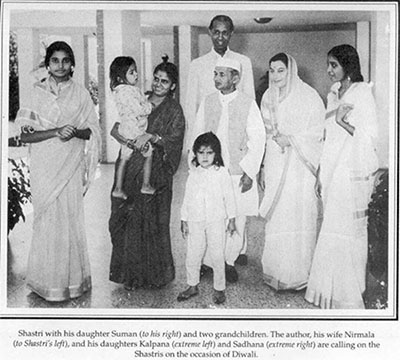
Mahatma Gandhi left a lasting impression on everyone who met him, including a little girl who used to stay at his ashram. This little girl was Shri Mataji, whom he nicknamed Nepali because of her Nepalese-like features.
From the age of seven, Shri Mataji spent much time with Gandhi at his ashram. “He would sit down with me, very seriously ask me very sweet questions,” recalled Shri Mataji, who often accompanied him during early morning walks before collective prayers.
“He was a tremendous hard master, but an extremely loving and compassionate person,” said Shri Mataji. “He always used to talk to me in a way as if I was a grandmother and he used to discuss things with me, most surprising to all others, in a way, (as if) I was wiser to everyone. And he said that guidance can be better from some children than from the older people.”
Shri Mataji later would praise Gandhi for establishing the base for dharma, inner religion or righteousness, in his country. He encouraged people to explore the Bible, to understand the Bhagavad Gita, to know all the great scriptures and great people of the world, and to understand them in an integrated way.
During her conversations with Gandhi, not only did they explore the inherent nature of the human personality, but also the ways and means to bring about social and spiritual liberation. When asked about her experience with Gandhi, Shri Mataji recounted one of their discussions: Gandhi was strict with his routine and had people waking at 4 a.m., fasting and so on, and Shri Mataji said to him, "You are too strict...isn't this all too much?"
Gandhi explained that it was necessary to have strict discipline during times of emergency when the country’s momentum for freedom was gaining speed.
To this Shri Mataji suggested, "Bapu, if you want to discipline people, why not give them discipline from within?"
Gandhi asked how it would be possible. She assured him that inner transformation was the answer. But he reasoned, "First of all, let us be free (from British rule). If we are not free, what can we enjoy? We cannot talk about it. People will say that we are not even free, how can we talk of freedom of Spirit? We should be free from foreign domination first."
In the following years, Gandhi’s message spread to the masses, from illiterate farmers to the more privileged classes and the most highly educated members of society. Shri Mataji also took part in the freedom struggle, setting an example for other college students to follow.
In 1947, India finally became a free nation. It had been many years since Shri Mataji’s childhood discussions with Gandhi, but not long before his last days, he asked to see her. “I met him…immediately he recognized,” Shri Mataji recalled. “He said, ‘Meet me after prayer.’ When I met him, he said, ‘Now take to constructive work. Take to constructive work...' ”
Shri Mataji continued studying the various problems facing human beings as well as possible solutions. It would be many years before she began her transformative work through Sahaja Yoga. Just as Gandhi had stirred the masses and guided his country to freedom, Shri Mataji’s work would transform not just a few individuals but hundreds of thousands worldwide. The time for inner freedom had come.
Shri Mataji’s childhood and teenage years were intertwined with the birth of the new Indian Nation, and her years as a wife and young mother proved to be equally so.
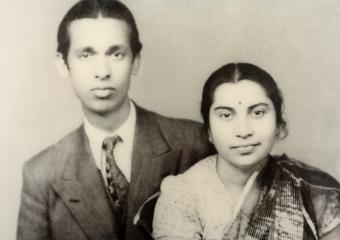
Nirmala Salve, now widely known as Shri Mataji Nirmala Devi, was married to Chandrika Prasad Srivastava on the 7th of April, 1947. One hundred and twenty nine days later, on August 14th, at the stroke of midnight, India became free.
As Shri Mataji’s younger brother H.P. Salve, fondly known as Babamama, recounted: “During the communal riots (at the time of the 1947 partition) there was an occasion when someone knocked at the door. When Nirmala opened it, she found one lady and two gentlemen standing at the entrance looking extremely frightened and scared. They told Nirmala that they were refugees from Pakistan and since one of them was a Muslim, the Hindus were after them, chasing them with drawn swords. Nirmala took them in without a moment’s hesitation and hid them in a room.
"After some time some people came with drawn swords," he continued, "and said that a Muslim was hiding in the house. Nirmala categorically denied this and bluffed them by saying that She was a staunch Hindu herself, so how could she give protection to a Muslim. The people with the swords initially did not believe her, but saw the large bindi on her forehead, which is symbolic of a Hindu married woman, so they went away convinced…”
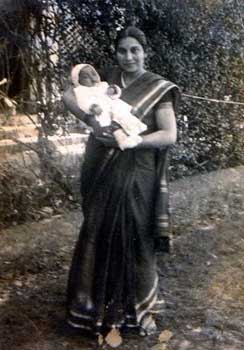
This incident took place during her pregnancy, and she delivered her first child, Kalpana, in the month of December 1947. On the 29th of January, 1948 Shri Mataji met Mahatma Gandhi, who took Kalpana on his lap and said, “Nepali (an affectionate nickname he had given Shri Mataji), you are the same to look at, now you are a mother. When are you going to start your spiritual work? Now we are free, you should start whatever you wanted to do.” Tragically, the next day, a political extremist assassinated Mahatma Gandhi as he attended evening prayers.
In 1948 Shri Mataji’s husband Chandrika Prasad (later widely known as Sir C.P. Srivastava, knighted by Queen Elizabeth II in 1990), was selected for the Indian Foreign Service and Indian Administration Service (I.A.S). Following Shri Mataji’s counsel, Sir C.P. elected to remain in the I.A.S. and serve his country from within its borders. During these busy first years of marriage, their second child, Sadhana, was born in February 1950. In May of that year, Sir C.P. was appointed to Lucknow as a city magistrate and the young family remained there for some time.
Late in 1951, Sir C.P. went to Meerut as the Additional District Magistrate. The staff bungalow was located on a sizable property and built in traditional British style. Shri Mataji, now with two small children, cultivated the land adjoining the bungalow. With the help of a farmhand, she converted the unused land into a very fertile vegetable garden. She grew vegetables for home use and sold the surplus to supplement their family income.
In his memoirs, H.P. Salve recalled, “Shri Mataji’s farm was regarded as the best farm in the district. The brinjal (eggplants) were so big that I could not lift them. She produced very, very big cauliflowers, very big tomatoes, very large cucumbers. It was unbelievable how she made such great-sized vegetables."
In 1953, Shri Mataji’s family moved to Mumbai when Sir C.P. was posted to the Directorate-General of Shipping (later to be called Shipping Corporation of India). H.P. Salve recalled wonderful summer holidays with Shri Mataji and her children at Pachmarhi, a hill station near Chhindwara, in central India, an area of great beauty with ancient caves, waterfalls, forests and wildlife. Shri Mataji and her family also spent a lot of time in Nagpur, where many of her relatives lived.
On Sunday, the 8th of February 1955, doctors admitted Shri Mataji’s father to the hospital. One week later all his children gathered around him. Shri Mataji was extremely close to her father and had always valued his advice, especially on spiritual matters. Her brother recalled that their father asked Nirmala “Have you been able to find the method?” - referring to the method of giving en masse realization. Surrounded by his family, Prasad Salve passed away two days later, on February 17th, 1955. H.P. Salve admired that Shri Mataji, “who would be filled with compassionate tears when she saw even one beggar, at that moment of great personal loss summoned up all her courage and started arranging for the funeral.”
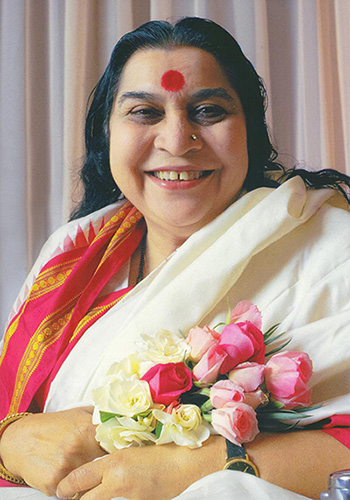
Shri Mataji's humanitarian and spiritual work draws admiration not only from countless individuals in more than 95 nations who have personally benefited from her teachings, but also from governments, dignitaries, educational institutions and humanitarian organizations.
Recognizing the scientific and verifiable nature of her teachings, the Petrovskaya Academy of Arts and Sciences in St. Petersburg bestowed an Honorary Membership upon Shri Mataji, telling her, “You are even higher than science.”
Others, such as Claes Nobel, thanked her for giving hope to humanity. She accepted all awards with characteristic humility, praising the efforts of others and insisting on collective, rather than individual, achievement.
Despite relentless travelling, Shri Mataji never referred to her demanding schedule as tiresome, equating it rather with the work of a loving mother looking after her children’s wellbeing.
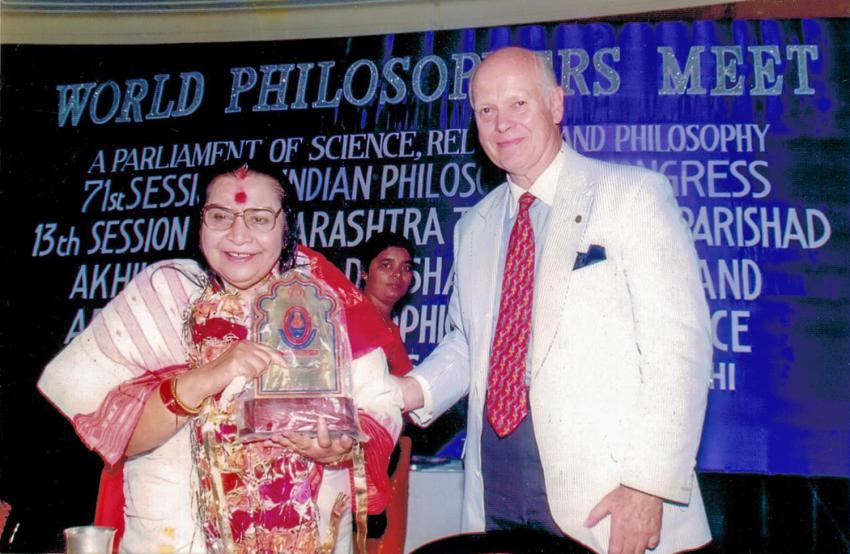
With Claes Nobel, Pune
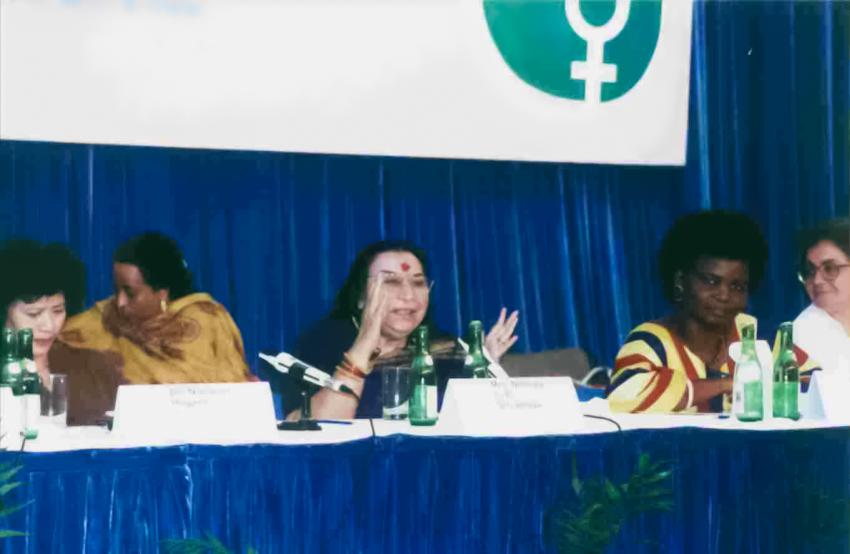
UN Conference, Beijing 1995
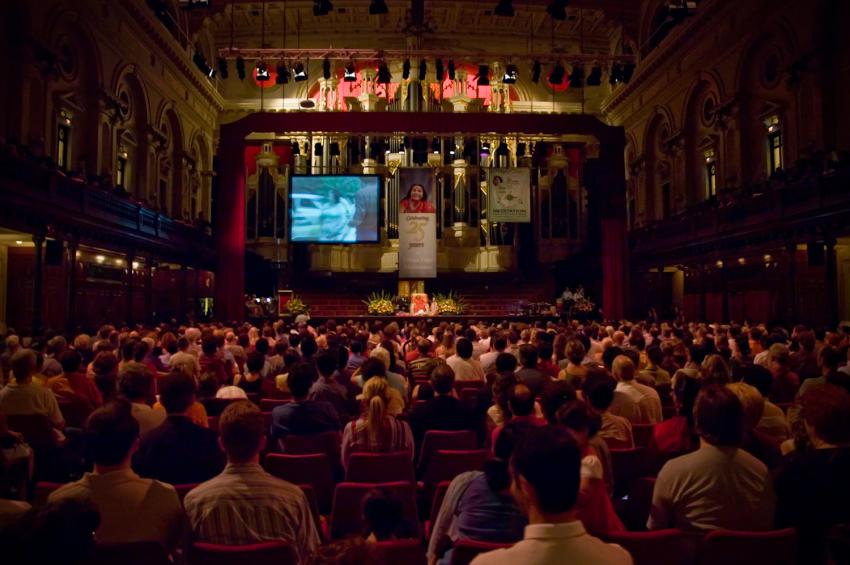
Self-Realization, Sydney 2006
Shri Mataji has been recognized worldwide by several prestigious institutions for her selfless work and for the remarkable results of her spiritual teachings through Sahaja Yoga, a few of which are listed below.
Italy, 1986
Declared ‘Personality of the Year’ by the Italian Government.
Moscow, Russia, 1989
Following Shri Mataji’s meeting with the USSR Minister of Health, Sahaja Yoga was granted full government sponsorship, including funding for scientific research.
New York, 1990-1994
Invited by the United Nations for four consecutive years to speak about the ways and means to achieve world peace.
St. Petersburg, Russia, 1993
Appointed as Honorary Member of the Petrovskaya Academy of Art and Science. In the history of the Academy, only twelve people have been granted this honour, Einstein being one of them. Shri Mataji inaugurated the first International Conference on Medicine and Self-Knowledge, which became an annual event at the Academy thereafter.
Brazil, 1994
The mayor of Brazilia welcomed Shri Mataji at the airport, presented her with the key to the city and sponsored all of her programs.
New York, 1994
September 26 proclaimed ‘Shri Mataji Nirmala Devi Day.’ Police escort was offered for a welcoming parade honouring Shri Mataji and celebrating her association with Mahatma Gandhi.
British Columbia, Canada, 1994
Romania 1995
Awarded Honorary Doctorate in Cognitive Science by Prof D. Drimer, head of the Ecological University Bucharest.
China, 1995
Official guest of the Chinese Government to speak at the United Nations International Women’s Conference.
Pune, India, 1996
On the occasion of the 700th Anniversary of Saint Gyaneshwara, Shri Mataji addressed the 'World Philosophers Meet '96 - A Parliament of Science, Religion and Philosophy,' where she was felicitated for her spiritual movement, Sahaja Yoga.
London, 1997
Mr. Claes Nobel, grandnephew of Alfred Nobel, chairman of United Earth and The National Society of High School Scholars, honoured the life and work of Shri Mataji in a public speech at the Royal Albert Hall.
USA, 105th Congress, 1997 and 106th Congress, 2000
Honorarium read into Congressional Record by Congressman Eliot Engle commending Shri Mataji for her dedicated and tireless work for humanity.
Cabella Ligure, Italy, 2006
Shri Mataji was awarded honorary Italian citizenship, which was followed by the unveiling of the foundation stone for the 'Shri Mataji Nirmala Devi World Foundation of Sahaja Yoga.' This Foundation has its home in Cabella Ligure.
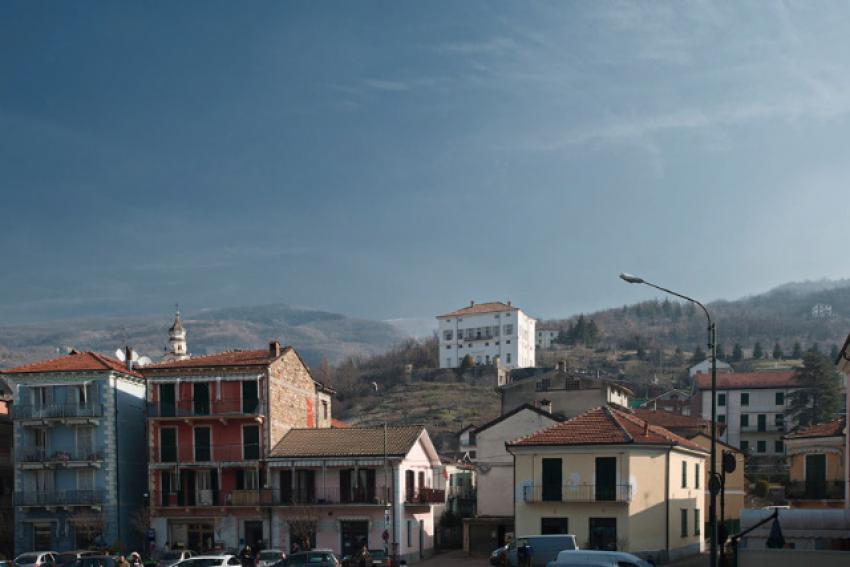
Cabella Ligure, Italy